Grants that
come back.
Capital to start the work you can't fund yet — no debt, no personal risk. As the work earns, the grant recovers, and you can come back for more. Capital that grows with you instead of disappearing after one use. See an example →
Give · raise · steward
Where do you fit?
Most giving is one-and-done. Ours recycles — the same dollar gives again. Whether you're giving, raising capital, or running a foundation, here's where to start.
Give once
Traditional giving — the dollar works once, then it's gone.
Give so it recycles ★
Your $100 gives again and again — the quadrant only we occupy.
I want to give
Find your giving fit
The giving guide and a short navigator — from everyday giving to your own foundation.
Start →I'm raising capital
What capital should you take?
For founders and non-profits — find the instrument that fits, from recoverable grants to more.
Start →I run or advise a foundation
Get the deed right — do more
Set one up well from day one, or make an existing foundation do more than grant 5%.
Start →Not sure where you fit? Talk it through with the concierge →
New to the language? Browse the glossary →
Working capital you can actually reach
Capital to fund the execution risk you can't carry alone — and as the work generates revenue, the grant recovers. The more it recovers, the faster you can come back for the next one: bigger, more frequent, even back to the same project. Recover fully, in instalments, or as revenue flows. The pool grows with you instead of disappearing after one use.
- Programme cap: AUD $150,000 total
- Structure: Recoverable advance — not a loan
- Eligibility: DGR-aligned charitable work — we confirm fit
- Programme cap: USD $100,000 total
- Structure: Recoverable advance — not a loan
- Eligibility: Charitable work — we confirm fit
The only thing that matters is the project: does the capital buy something that generates revenue you can recover from? If it does, this is for you — if not, we'll point you to a grant.
Cash to deliver a paid contract you can't yet fund — and the capital recovers as that contract pays out.
Equipment or kit that earns — a produce fridge, a greenhouse, a commercial kitchen — recovered from the income it throws off.
Build the thing that starts the trade — a café, a workshop, a social enterprise — that recovers from what it then earns.
Recoverable agreement, not a credit facility — no enforceable debt obligation.
No directors' guarantees, no asset claim, no individual liability for trustees.
Operates as a recoverable grant, not a financial liability. Your auditor sees what they'd see for any grant.
Then it's a regular grant. The community was served. No one comes after you. That's the deal.
Most grants disappear after one use
A donor gives. A nonprofit spends. Then both sides start the fundraising cycle over. Most NFPs know the next contract or grant is coming — they just can't reach it without working capital now. So they take on debt, shrink the program, or watch the deployment window close.
NABU had the contract.
It just couldn't start.
NABU had a signed contract to produce a large set of children's books — but couldn't fund the production upfront, before the payments came in. Here's the difference recoverable capital made.
This isn't a theory.
The sector is asking for it.
in charitable funding consumed globally each year — every dollar, used once and gone
of nonprofits are loss-making or just breaking even — single-use capital makes this worse
of NFPs drew down financial reserves last year just to keep operations running
Budget pressure is the top challenge for NFPs of every size — rising costs outpacing income
Sources: Johnson Center for Philanthropy / Philanthropy Together, ‘Rooted in Community’ (2026). CEP Grantee Perception Report 2025.
The community gets the same thing.
But the money doesn't disappear.
Steps 1 through 3 are identical for the community. The only difference is what happens to the money afterwards.
Worst case: the recovery never lands and it's a regular grant. Community still served. Same outcome as any traditional grant.
The mechanics are simple
The organisation gets what it needs
An organisation needs capital — to deliver a program, bridge to a confirmed contract, or buy an asset that earns. The donor pool advances it under a recoverable agreement. They get the cash or the asset on day one.
No strings attached
The organisation operates freely under a simple recoverable agreement. They didn't borrow anything. No debt, no personal guarantees.
The grant keeps working
When their future revenue lands — a grant tranche, a contract milestone, fees, earned revenue, royalties — it flows back to the pool. The community was served, and the capital starts recovering.
The next community benefits
Over time, the capital recovers. The pool can now fund the next organisation — without raising another dollar. Same dollar, multiple cycles, indefinitely.
Sounds like a lot to manage? It would be. That's why the platform handles all of it — sourcing, agreements, tracking, reporting. Organisations apply, donors give, and the operational layer stays out of the way.
Not every deployment
will recover fully
Some assets will generate strong revenue and recover in 12 months. Some will recover slowly. Some won't recover at all — and those are still good grants that served your community.
The model doesn't need 100% recovery to be transformative. Under the traditional approach, 0% of grants recover. Even partial recovery changes the equation fundamentally.
We'd rather show you an honest spectrum than a best-case projection. This is about making your fund stretch further — not promising magic.
Some grants won't recover. That's fine — they still funded community assets. Same as any traditional grant.
Some recover partially. You get back 40–70% of the capital. Still dramatically better than 0%.
Some recover fully in 12–24 months. That capital is now available for the next deployment.
Over time, even modest recovery rates compound meaningfully. Your fund serves more communities without raising another dollar.
Featured at the Global Philanthropy Forum 2026
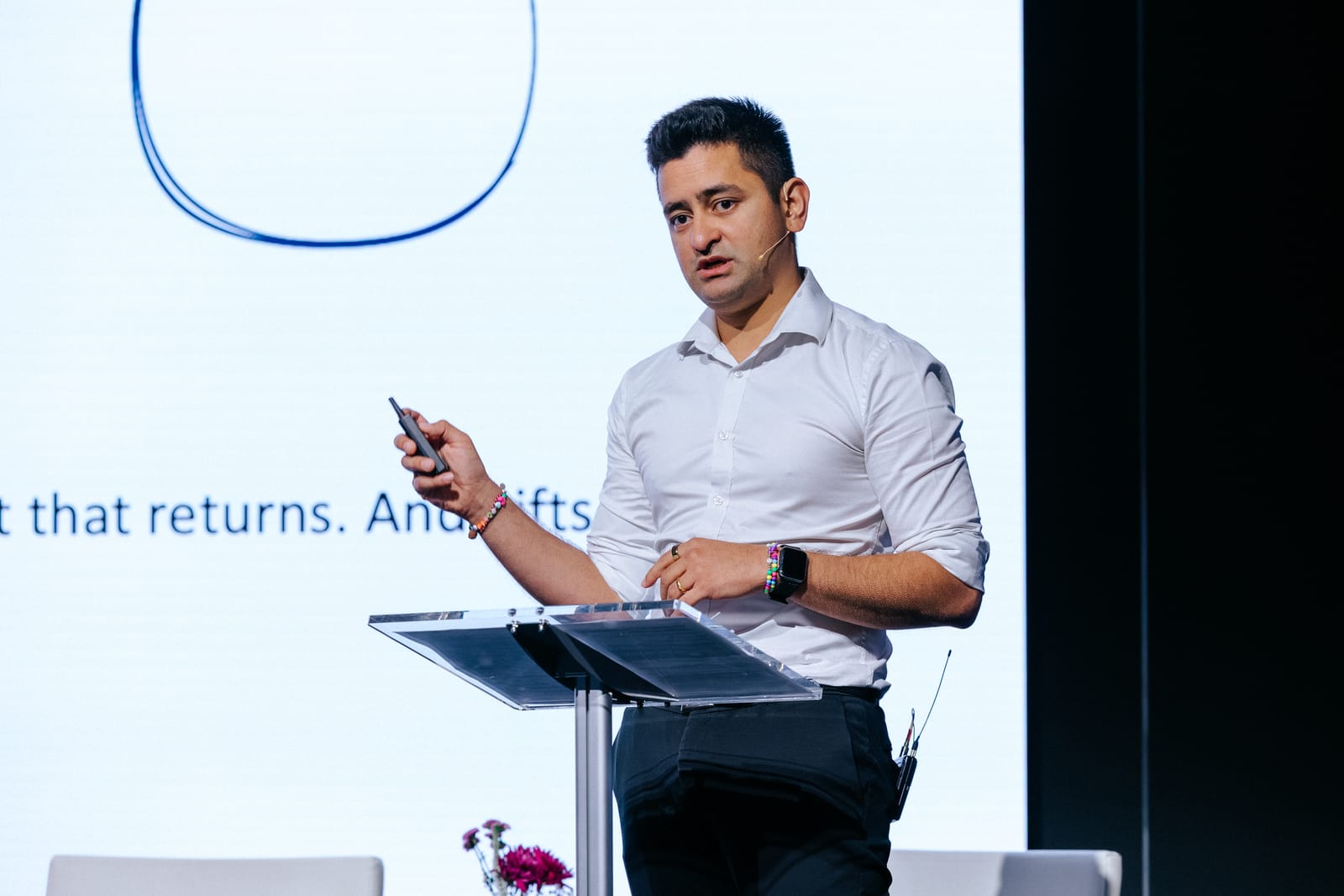
Marquee session: “Capital as Code: Rearchitecting the Rules of Ownership, Power, and Agency.”
Founder Rosh Ghadamian closed the session presenting “Shared Protocols for a New Operating System” — how regenerative capital design can capitalise institutional agency rather than reproduce scarcity.
- Ford Foundation
- GiveDirectly
- B Lab
- Ownership Works
- Artha Impact
- Full Spectrum Capital Partners
“Charitable money does extraordinary work in communities — and then it disappears. We're building the infrastructure so the same dollar can help the next community, and the next.”
Let's talk
Whether you're a nonprofit, a donor, or a foundation — no pitch deck, no agenda. Send a message and we'll come back to you.
Not ready to talk yet? Use the form above and mention you'd like the two-page summary — no follow-up unless you want it.